
Understanding Sovereign Cloud: Control, Compliance, and Confidence in the Digital Era

For more than a decade, public cloud has powered digital transformation. Enterprises adopted hyperscale cloud platforms to reduce costs, scale rapidly, and accelerate innovation. However, as cloud usage expanded deeper into core business and government operations, a fundamental question emerged:
Who truly controls the data, the infrastructure, and the decisions made by digital and AI‑driven systems?
Rising concerns around data privacy, regulatory compliance, geopolitical risk, national security, and AI accountability have moved sovereign cloud into the spotlight. Governments and regulated industries worldwide are reassessing where digital systems operate, who governs them, and under which legal jurisdictions they fall.
This blog explores what sovereign cloud truly means, why it matters more today than ever before, and how organizations can make informed cloud choices in a hybrid, AI‑driven world.
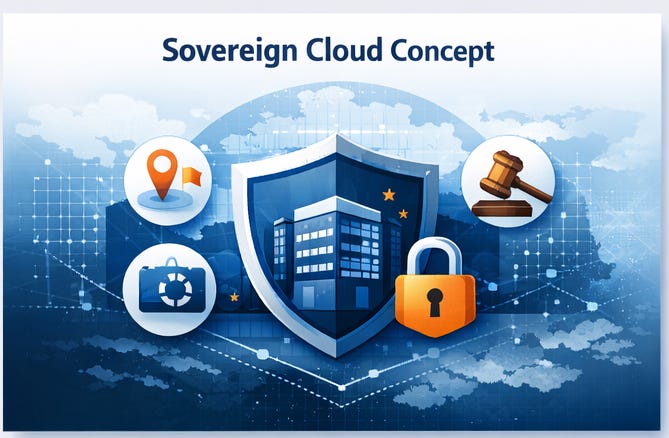
What Is Sovereign Cloud?
A sovereign cloud is a cloud environment designed to ensure that data, workloads, and operational control remain under the legal jurisdiction of a specific country or region.
Unlike traditional public cloud environments—where infrastructure may span multiple countries and administrators may operate globally—a sovereign cloud enforces strict boundaries on:
Where data is stored and processed
Who can access systems and data
Which laws and regulators apply
Sovereign clouds are typically operated by domestic providers or trusted local partners of global hyperscalers, operating under clearly defined sovereignty and compliance controls.
At its core, sovereign cloud is not just an infrastructure choice. It is a governance and trust model.
The Concept of Digital Sovereignty
Sovereign cloud is part of a broader idea known as digital sovereignty—an organization’s ability to maintain control, independence, and transparency over its digital assets.
In simple terms, digital sovereignty means an organization can decide:
Where its data lives
How systems are operated
Which technologies are used
How AI models behave and make decisions
Digital sovereignty becomes especially critical in environments involving sensitive data, regulated industries, and AI‑driven decision‑making.
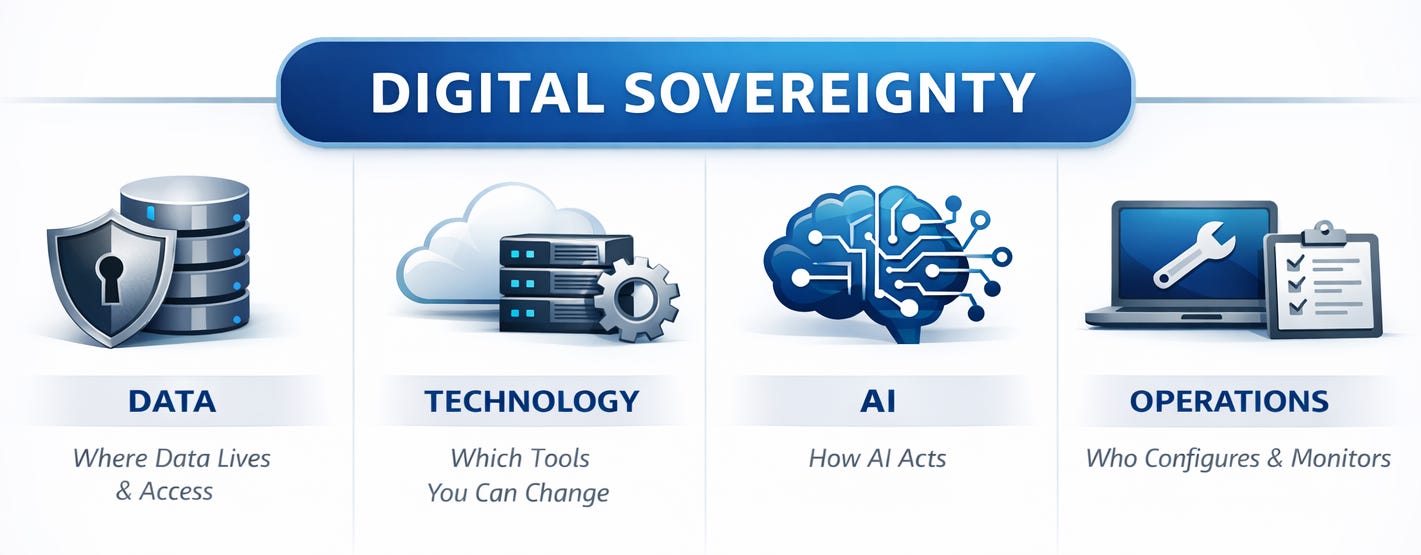
The Four Pillars of Digital Sovereignty
Digital sovereignty rests on four tightly interconnected pillars:
1. Data Sovereignty
Data sovereignty ensures organizations know exactly:
Where their data is stored
Who can access it
How it is protected under legal and regulatory requirements
This is particularly important for personal, financial, healthcare, and government data.
2. Technological Sovereignty
Technological sovereignty provides freedom of choice. Organizations can:
Select cloud platforms and tools intentionally
Avoid long‑term vendor lock‑in
Change providers when business or regulatory needs evolve
3. AI Sovereignty
As AI becomes embedded in critical decisions, AI sovereignty ensures:
AI models run in approved environments
Decisions are explainable and auditable
Fairness, accuracy, and drift are actively governed
This is foundational for responsible AI.
4. Operational Sovereignty
Operational sovereignty defines who controls:
System configurations
Updates and patches
Monitoring and incident response
It answers a simple but powerful question: who runs the system when it matters most?
Public Cloud vs Sovereign Cloud: What’s the Difference?
While both models provide cloud capabilities, the difference lies in control and jurisdiction.
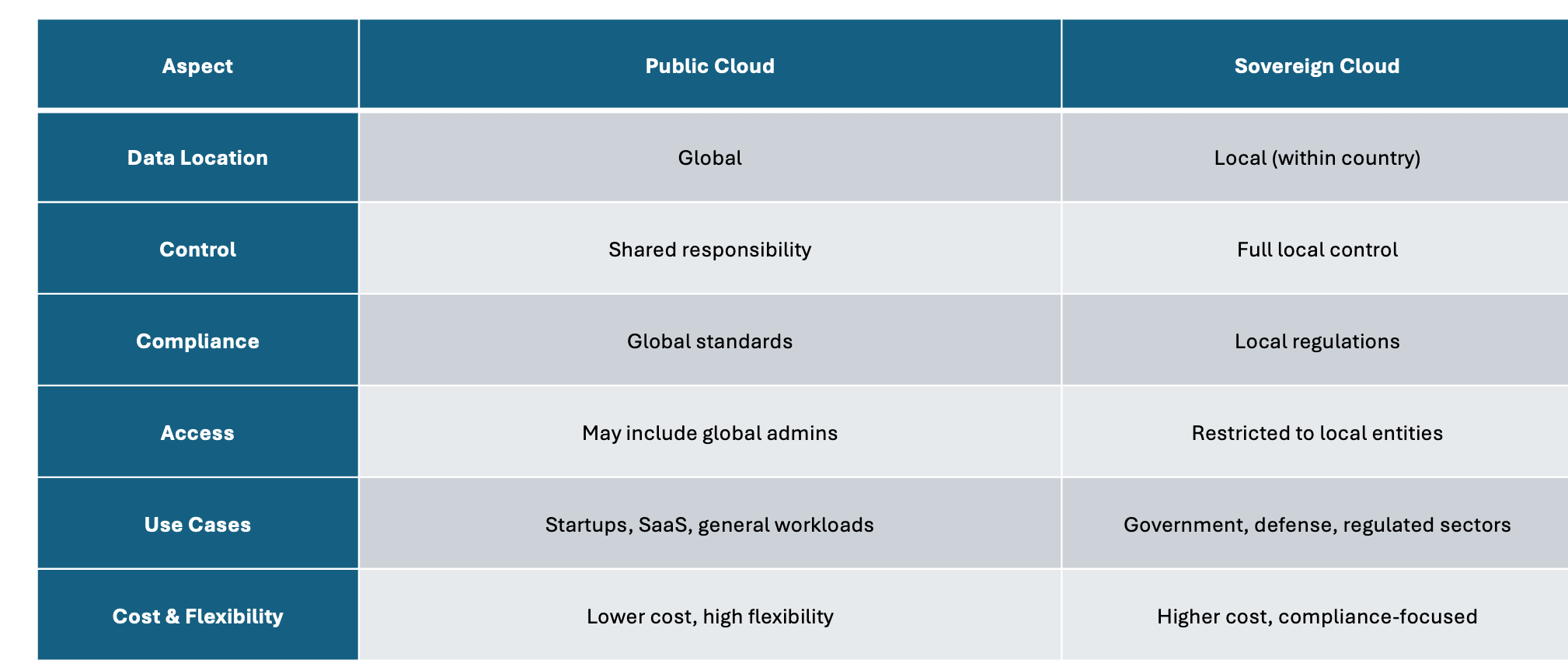
Key takeaway:
Public cloud optimizes for speed and scale, while sovereign cloud prioritizes control and compliance.
Why Sovereign Cloud Is Gaining Importance
Globally, regulations are tightening:
Europe: GDPR and digital sovereignty initiatives
India: Digital Personal Data Protection (DPDP) Act
Other regions: Increasing focus on data localization
Organizations are being asked:
Where is your data stored?
Who controls it?
Who can legally access it?
Additionally, geopolitical concerns and laws like the U.S. Cloud Act have raised fears of foreign data access—even when data is stored abroad.
The Role of Hybrid Cloud
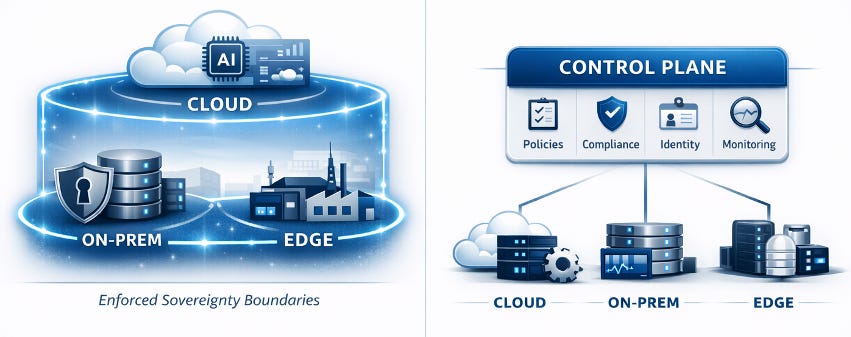
In reality, most organizations cannot rely on a single environment.
A hybrid cloud approach combines:
Public cloud → for scalability and innovation
Sovereign/on-prem environments → for sensitive workloads
Edge computing → for real-time decisions
This allows organizations to:
Innovate rapidly
Maintain compliance
Minimize unnecessary data movement
Industry Use Cases: Choosing the Right Model
Different sectors prioritize different needs:
Public Cloud Works Best For:
Startups and digital-native companies
Web and mobile applications
AI/ML workloads requiring scale
DevOps and CI/CD pipelines
Sovereign Cloud Is Essential For:
Government services (e.g., digital identity, taxation)
Healthcare systems handling patient data
Financial institutions with strict compliance needs
Critical infrastructure like power grids and defense
The Strategic Shift for Indian Organizations
The decision is no longer public cloud vs sovereign cloud.
The real question is:
How do we combine both while staying DPDP‑compliant, regulator‑ready, and innovation‑driven?
Leading providers are already adapting in the Indian market through:
India‑aligned sovereign cloud offerings
Local data residency and access controls
Regulator‑friendly audit and governance models
India’s sovereign cloud momentum is accelerating through MeitY frameworks, RBI supervision, and public‑private partnerships.
Final Thoughts: Sovereignty Enables Confident Innovation
Sovereign cloud is not about rejecting modern technology.
It is about:
Maintaining control while scaling innovation
Building trust with customers and regulators
Ensuring compliance without slowing down growth
Organizations that embrace a hybrid strategy with strong governance can achieve the best of both worlds:
Agility of public cloud
Control of sovereign environments
In today’s digital landscape, sovereignty is not a limitation—it is a strategic advantage.